
Your CCTV System Is Watching. It Just Isn't Thinking.
- The AISI Team

- Mar 16
- 4 min read
Updated: Mar 16
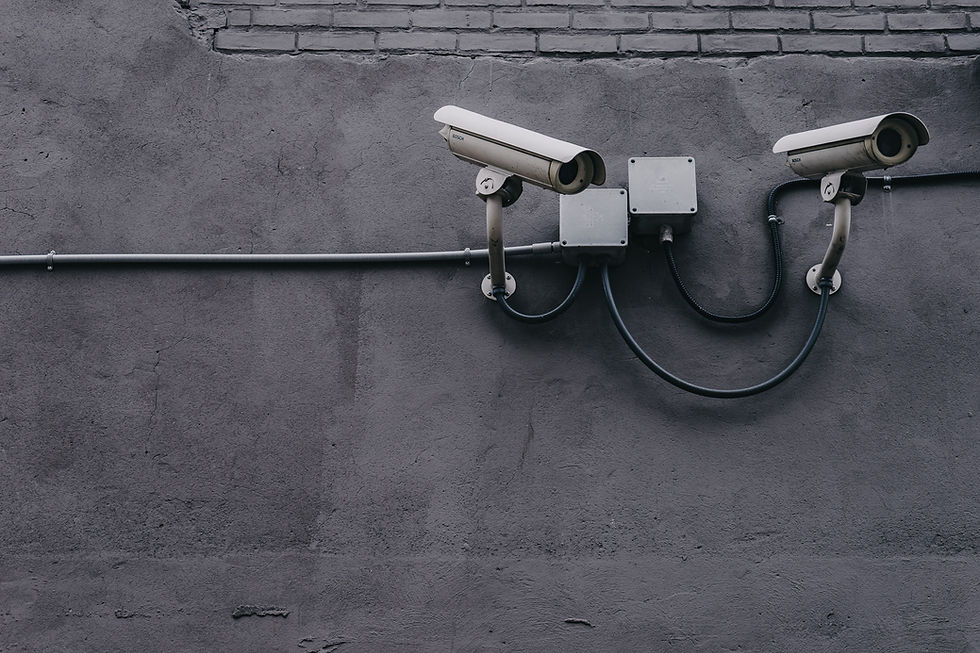
Most organisations believe their surveillance network gives them visibility. It doesn't. It gives them footage.
There's a meaningful difference. A camera that records a safety violation hasn't prevented it. A camera that captures an access breach at 2am
only matters if someone is watching at 2am — and in almost every organisation, no one is.
The problem isn't too few cameras. Most organisations have plenty. The problem is that cameras without intelligence are a passive archive. They tell you what happened. AI video analytics tells you what is happening — and often, what's about to.
The scale problem human monitoring can't solve
A mid-sized airport processes hundreds of thousands of baggage movements daily. A large construction site runs sixty to eighty camera feeds simultaneously. A worker dormitory never truly switches off.
No monitoring team can cover this meaningfully in real time — not because they aren't skilled, but because the math doesn't work. Research shows that human observers begin missing significant events after roughly twenty minutes of continuous monitoring. Expecting a control room team to stay sharp across dozens of live feeds isn't a safety strategy. It's a liability.
What AI video analytics does is give your existing team a force multiplier: a system that watches every feed simultaneously, never fatigues, applies consistent detection logic, and surfaces only the events that actually need human attention. The people don't disappear — they just stop drowning in noise and start focusing on what matters.
Where it delivers the most immediate impact
Aviation and transport. At Hong Kong International Airport, AISI deployed AI video analytics for real-time baggage monitoring — identifying deviations from expected movement patterns before a misrouted or unattended item progresses through the facility. Beyond catching anomalies faster, the system builds an auditable, time-stamped record of every event. In an environment where regulatory compliance is continuous, that paper trail is as valuable as the detection itself. Read the HKIA case study →
Construction, shipyards and industrial sites. Falls account for more than half of all construction-related fatalities, and the physical complexity of an active site makes consistent oversight genuinely difficult. AI video analytics goes well beyond PPE detection — it monitors restricted zone access, tracks heavy equipment near workers, flags unsafe configurations, and auto-generates incident documentation the moment something happens. Some companies have reported incident reductions of 40 to 50% after deployment. That's not marginal improvement. That's the difference between reacting to incidents and preventing them.
Facilities and worker accommodation. For Cyclect Group, AISI deployed AI video analytics across a worker dormitory — a facility that operates around the clock and must maintain safe, secure conditions for a large resident population. The challenge isn't dramatic safety events; it's the steady, continuous management of access, occupancy, and behaviour across a site that never sleeps. AI monitoring handles this automatically and flags only what genuinely needs human follow-up. Read the Cyclect case study →
Smart city infrastructure. In Wugang, China, AISI deployed AI video analytics across city infrastructure — supporting public safety monitoring and anomaly detection at genuine city scale. The goal wasn't to replace human management capacity. It was to give that capacity somewhere useful to focus, rather than being overwhelmed by thousands of simultaneous feeds generating mostly nothing. Read the Wugang case study →
The infrastructure point most people get wrong
Here's something worth saying clearly: in most deployments, you don't need new cameras. The intelligence is added as a software layer on top of your existing infrastructure. That completely changes the ROI conversation — you're not evaluating the cost of a new surveillance system, you're evaluating the incremental cost of making your current one actually work for you.
When you factor in the operational overhead of manual monitoring, the cost of safety incidents, and the exposure from compliance failures, the question isn't usually "can we afford this?" It's "why haven't we done this already?"
The question worth asking your team today
What is your current footage actually doing between incidents?
Not when something goes wrong — when footage becomes evidence. On a normal Tuesday afternoon, when nothing has happened yet. Is it being actively monitored? By how many people, across how many feeds? What's the realistic probability a meaningful event gets caught in real time rather than discovered in retrospect?
For most organisations, the honest answer is uncomfortable. The cameras are recording. Almost none of it is being used to prevent anything.
AI video analytics changes that. The cameras are already there — the question is whether they're working as hard as they could be.
Deployment is an operational project, not just a tech install
Organisations that get this right treat AI video analytics as an operational integration effort. That means thinking through how alerts are routed, who receives them, and within what response time. It means calibrating detection parameters to your specific environment — not applying generic defaults. And it means choosing an implementation partner with real domain depth, because a system tuned for airport baggage handling behaves very differently from one built for a construction site.
At AISI, this is what we mean by applied intelligence — not AI as a capability
demonstration, but AI embedded in how your operation actually works, so the system your team relies on at month twelve is still the one that was worth deploying in month one.
AISI is a Singapore-based AI solutions provider specialising in AI Video Analytics, AI Agents, and Enterprise AI implementation. Our video analytics solutions can work with your existing camera infrastructure or install new ones to deliver real-time operational intelligence. Reach us at specialist@aisi-asia.com
Comments